
UzimaNexus Joins the Inaugural Cyber4Africa Cohort
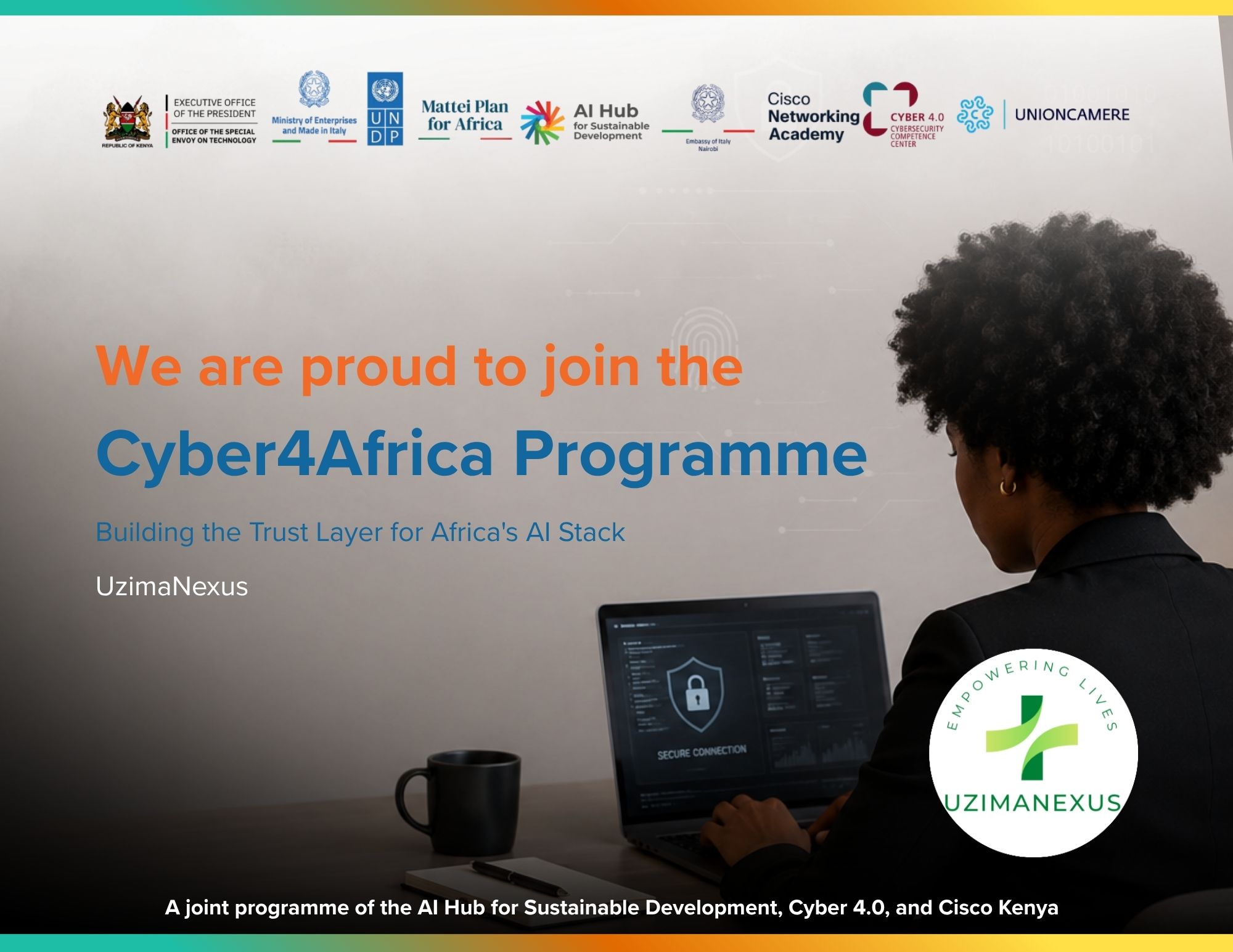
UzimaNexus has joined the inaugural cohort of the Cyber4Africa Programme. The AI Hub for Sustainable Development has marked the cohort's official launch and encouraged the selected startups to share the news with their networks, so here is ours. The cohort listing names UzimaNexus among its HealthTech companies from Kenya, and the graphic the programme team sent us carries a line we would have chosen for ourselves: building the trust layer for Africa's AI stack.
The Cyber4Africa Programme is run by the AI Hub for Sustainable Development, which describes itself as a G7-endorsed, MIMIT-UNDP co-led initiative aligned to the Italy-Africa Mattei Plan. It is delivered together with Cyber 4.0 and Cisco Kenya. The programme was unveiled in Nairobi in February 2026 at the Nairobi AI Forum, co-organized by Italy, Kenya, and UNDP, and it runs for six months from July 2026.
Cyber 4.0 is one of eight national competence centers established and co-financed by Italy's Ministry of Enterprises and Made in Italy, specializing in cybersecurity. The AI Hub says the cybersecurity posture assessment is delivered with the support and technical expertise of Cyber 4.0 and Unioncamere, the Italian Union of Chambers of Commerce, and that capacity building includes sessions hosted at Cisco's Cybersecurity Training Centre in Nairobi.
The AI Hub puts the cohort at 49 startups from 13 countries, working across five priority sectors where cybersecurity exposure is most acute: healthcare and digital health, fintech and financial services, govtech and civic technology, energy and climate technology, and AI infrastructure and data platforms. The work is organized into three integrated workstreams: a cybersecurity assessment, capacity building, and technical support.
For a company in our position, none of this is abstract. UzimaNexus is building an AI-powered, blockchain-secured healthcare operating system, which means the records we hold are among the most sensitive a person has: diagnoses, lab results, prescriptions, and the history of every visit. Unifying records that were scattered across clinics, labs, and pharmacies is what allows care to follow the patient, and it also concentrates risk that fragmentation used to spread thin.
Security is not a feature bolted onto that architecture; it is the condition everything else depends on. Our platform brings together unified patient records, AI clinical decision support, automated clinical workflows, and a blockchain-based consent and data trust layer in a single HIPAA-compliant, interoperable system, and our patient-facing app, My Doktari, runs on the same infrastructure. The consent layer is designed so that patients decide what is shared and with whom.
Trust is as much our product as the software is, and it has to be engineered rather than asserted. Our UziCoin health incentive program rewards patients for sharing data ethically and on their own terms, and that promise only holds if the engineering behind it holds. The models are already good enough to be useful; what decides whether African health AI reaches patients is whether the data underneath it can be trusted.
Over the coming months, we will formalize the security foundations we have already built. Our priorities are stronger governance for sensitive patient data, security by design in our AI systems from the outset, internal capacity so that resilience does not rest on any one engineer, and alignment with internationally recognized standards. We are not starting from zero, and we are not pretending the work is finished.
Our Founder and CEO, Prudence Ibila, a biomedical engineer, sets strategy at the intersection of AI, blockchain, and healthcare infrastructure, and our CTO, Alvin Masse, leads the engineering behind the system. Thank you to Keyzom Ngodup Massally, AI Hub Director, and the team at the AI Hub, to Cyber 4.0 and Unioncamere, to Cisco Kenya, and to UNDP and the Ministry of Enterprises and Made in Italy. Thank you as well to the 48 other teams in the cohort, who are asking the same questions in fintech, govtech, energy, and AI infrastructure.
In health technology, cybersecurity is not a compliance box to be checked; it is the difference between a patient sharing their history and withholding it. We remain focused on our north star: making quality, intelligent, and trustworthy healthcare accessible to every African. 🌍