
UzimaNexus Joins African AI Companies and G7 Industry in Rome
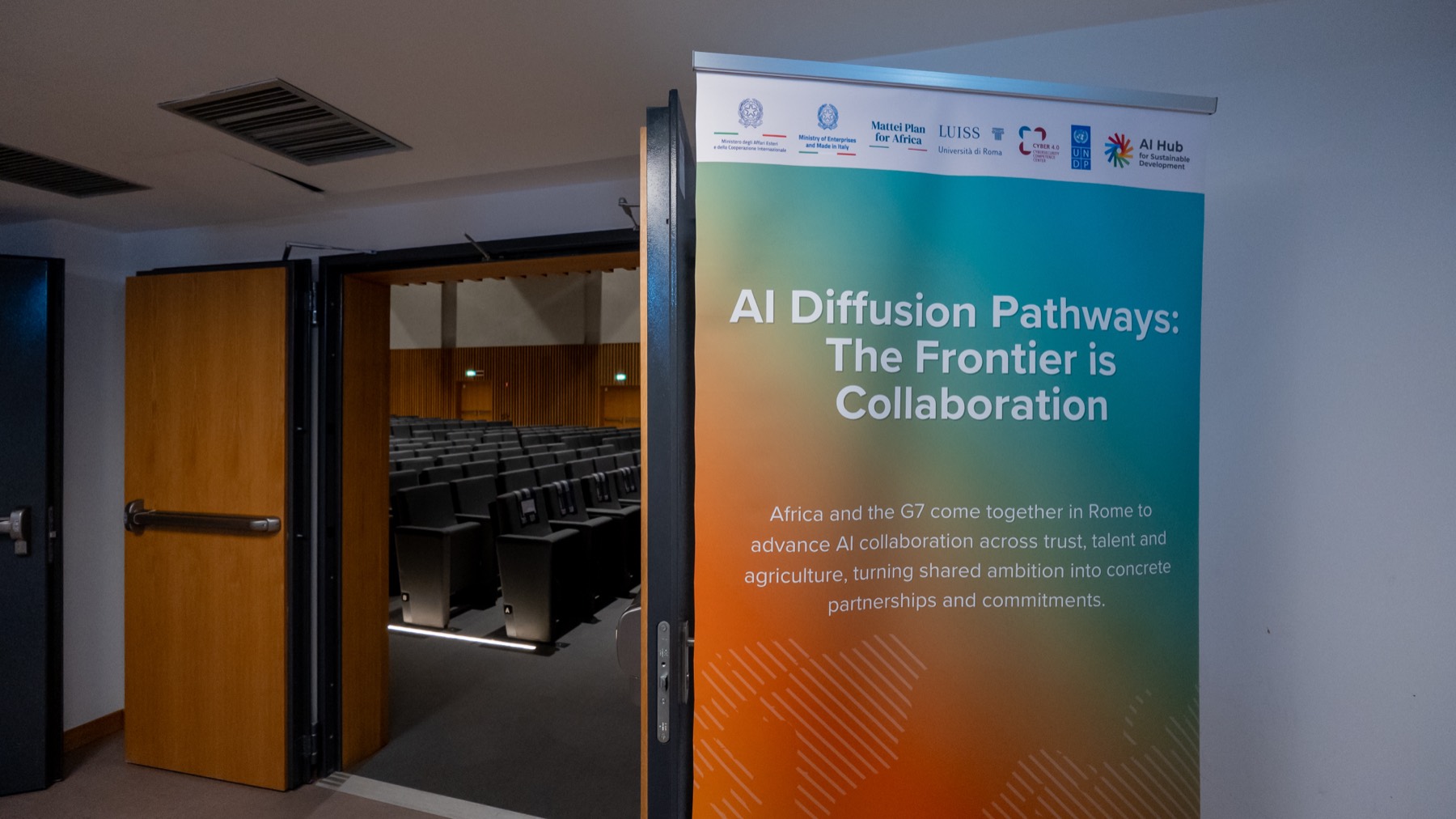
UzimaNexus joined African AI companies and G7 industry in Rome on November 3. The occasion was AI Diffusion Pathways: The Frontier is Collaboration, convened by the AI Hub for Sustainable Development at Luiss Guido Carli University, in collaboration with Italy's Ministry of Enterprises and Made in Italy (MIMIT), the Ministry of Foreign Affairs and International Cooperation (MAECI), UNDP, and the Cyber 4.0 National Cybersecurity Competence Center. The banner at the door set out what the day was for: advancing AI collaboration across trust, talent, and agriculture, and turning shared ambition into concrete partnerships and commitments.
UNDP's account of the day opens with its central argument: the next frontier of AI is not building better models but getting AI into the hands of the farmers, businesses, and governments who need it, with the private sector leading the way. In health, the same holds for clinicians and patients. A model that performs well in testing has done nothing for anyone until it reaches the clinic where a patient is seen, works with the records that clinic keeps, and earns the trust of the people who use it.
Senator Adolfo Urso, Italy's Minister of Enterprises and Made in Italy, said: “Artificial intelligence can accelerate Africa's development by improving access to healthcare and skills and giving young people opportunities to start businesses and find employment.” He described the AI Hub, launched in partnership with UNDP during Italy's G7 Presidency, as the vision of the Mattei Plan put into practice. The Mattei Plan counts 76 projects launched across 18 countries, and the AI Hub has engaged more than 1,100 African innovators and over 150 Italian organizations, with more than 7,000 startups registered. Healthcare was the first gain the Minister named, and it is the one we work on.
Trust is the thread closest to our work. Cyber 4.0 presented Cyber4Africa, the initiative supporting 49 AI startups from 13 countries in strengthening their cyber resilience, and the cohort UzimaNexus joined in September. Business-to-business matchmaking at the event opened new opportunities for those startups to connect with Italian and European markets. Matteo Lucchetti, Operation Director of Cyber 4.0, put it plainly: “Cybersecurity and trust are essential enablers for the sustainable growth of AI.”
For a company that holds health records, that is not a slogan. Diagnoses, lab results, and prescriptions are among the most sensitive data a person has, and a patient who does not trust a system will not share the history that makes good care possible. That is why our platform pairs unified patient records and AI clinical decision support with a blockchain-based consent and data trust layer, and why we treat cyber resilience as part of the product rather than something added later.
On agriculture, the AI Hub and DeepLeaf, a Moroccan agritech company, launched an AI foundation model for food security, built on DeepLeaf's African-developed model already validated in Kenya, Morocco, and Italy. In seven countries (Italy, Morocco, Tunisia, Kenya, Ghana, Tanzania, and Rwanda), local agritech startups will build their own solutions on one shared model. Data is shared with consent, solutions stay locally owned, and open components return as digital public goods. It is a different sector from ours, but the design will be familiar to anyone building health infrastructure, and DeepLeaf summed it up in a line that applies just as well to clinical AI: AI creates evidence, not authority.
The same question of authority sits at the center of the AI Hub's work on governance. Its view is that AI governance is made every day, in the choices companies make as they build and deploy AI: what to build, whose data to use, and who makes the final call. Through Anima Mundi, the AI Hub invites companies to bring those choices forward by pairing a real AI decision with a living tradition from their own culture. Among the first submissions, Horus Labs chose right-sized infrastructure over hyperscale, Harmonic Innovation Group is embedding ethics into its model from the start while keeping final judgment with people, AI Senegal asks whether scraping local data is a gift or a taking, and Crane AI Labs keeps the midwife, not the machine, accountable for clinical decisions.
That last example is the one closest to home. In health AI, accountability belongs with the people providing care, and clinical decision support should inform a clinician's judgment rather than replace it. It is the standard we hold our own clinical decision support to. The AI Hub is now looking for submissions from startups and industry worldwide, so that the practices of those building AI inform how AI is governed.
On talent, AI is creating new kinds of work, from evaluating and assuring AI systems to adapting them to local languages and sectors. Building on the AI Hub's work on AI jobs and skills diffusion, a new Datapizza–Zindi partnership will connect African and Italian AI talent to these roles through joint hackathons built around companies' real needs. The aim, in the organizers' words, is skills that find work and careers built in local ecosystems, a point also emphasized by Daisy Ireton, Senior Partnerships Manager at Apolitical, which partners with the AI Hub to strengthen AI skills across the public sector.
The Rome event built on the seven Africa–Europe partnerships signed in Bologna in June, and marked what the organizers describe as the next phase of that cooperation: moving beyond access to computing infrastructure and talent toward the trust, strategic partnerships, and market opportunities needed to scale AI innovation. That sequence mirrors our own path with the AI Hub. We were selected as one of the 100 Compute Curious organizations in its Compute Accelerator Programme in 2025, and joined its Cyber4Africa cohort this year. Rome was about the step that comes after both, and for us that step is deployment where care is actually delivered.
Thank you to the AI Hub for Sustainable Development for convening the day, and to MIMIT, MAECI, UNDP, Luiss Guido Carli University, and Cyber 4.0 for making it possible. Thank you as well to the African AI companies who took part alongside us, including Armstrong Education, Data Analytics Solutions, DeepLeaf, Digital Umuganda, Hasab AI, Horus Labs, Jokalante, NextAV, Oomus, PAWA AI, and Vambo AI.
The frontier, as the event's title put it, is collaboration. In health, that means models that reach the clinic, data that patients are willing to share, and accountability that stays with the people providing care. We remain focused on our north star: making quality, intelligent, and trustworthy healthcare accessible to every African. 🌍